White crust on faucets and showerheads
Hardness minerals, mostly calcium and magnesium, left behind as scale.
Water softener
Valdosta, GA · Softeners, filters & well treatment
Before anyone sells you equipment, find out what's actually in your water. Water softener installation in Valdosta makes sense for some homes and not others, because a softener only fixes hardness and does nothing for a sulfur smell, a chlorine taste or sand in the lines. City water and private well water are also very different starting points. Call Plumber Valdosta Fix, describe what you're seeing, and you'll hear what fits and the price before anything is installed. Test first, then treat.
Scale, smell or stains? Call and find out what your water needs.
10+Years helping homeowners get it fixed
What you're seeing
Three of these six point to a softener. The other three point to a filter, and a softener won't touch them.
Hardness minerals, mostly calcium and magnesium, left behind as scale.
Water softener
The same minerals drying on every surface the water touches.
Water softener
Hard water reacting with soap instead of rinsing clean.
Water softener
Hydrogen sulfide gas, most often from a private well.
Carbon or oxidizing filter
Iron in the water, sometimes with manganese.
Iron filter
The disinfectant the City adds on purpose so water stays safe in the pipes.
Carbon filter
Know your starting point
Valdosta's City water and private wells come from the same groundwater, but only one of them is treated before it reaches the tap.
City water
City water starts as groundwater, pumped from the Upper Floridan aquifer by seven deep wells. The plant then treats it in four steps.
The plant's process, as the City describes it, doesn't include softening. If you dislike the chlorine taste, that's a carbon filter's job.
Private well
A private well delivers groundwater as it comes out of the ground. The same sulfur the City strips out at its plant can reach your faucets, along with iron, sediment and hardness that vary from well to well.
For private wells, the EPA's yearly test covers total coliform bacteria, nitrates, total dissolved solids and pH. Before choosing treatment equipment, ask the lab to check hardness and iron as well.
Well pump repair in ValdostaBeyond softening
A softener and a filter do different jobs. Filters handle what a softener can't, like sediment, chlorine, iron, sulfur and bacteria.
Most systems are built from a few of these stages in a row, chosen from the water test. More stages isn't better; the right ones are.
Catches sand, grit and rust flakes before they reach fixtures and appliances.
A common first stage on wells.
Removes chlorine taste and smell, and many chemicals and odors.
Often placed ahead of a softener to protect its resin.
Oxidizes and traps iron, manganese and hydrogen sulfide.
The usual answer to orange stains and sulfur smell.
Strips most dissolved solids from drinking water at one tap.
Sits under the kitchen sink, not whole-house.
Kills bacteria passing through, without adding chemicals.
Used on wells that test positive for bacteria.
Private wells
On a well, the order of equipment matters as much as the equipment itself. Each stage protects the one after it.
Bacteria, nitrates, hardness, iron, pH and sulfur. The results decide everything after.
Grit and sand come out before anything that could clog.
An iron or oxidizing filter handles stains and the rotten egg smell.
The softener goes after the iron filter, so it only has hardness to deal with.
UV at the end when the test shows bacteria.
Be wary of a free in-home test from someone selling equipment. A lab test, or one from a company that isn't pitching a particular system, gives you numbers you can compare.
Putting it in
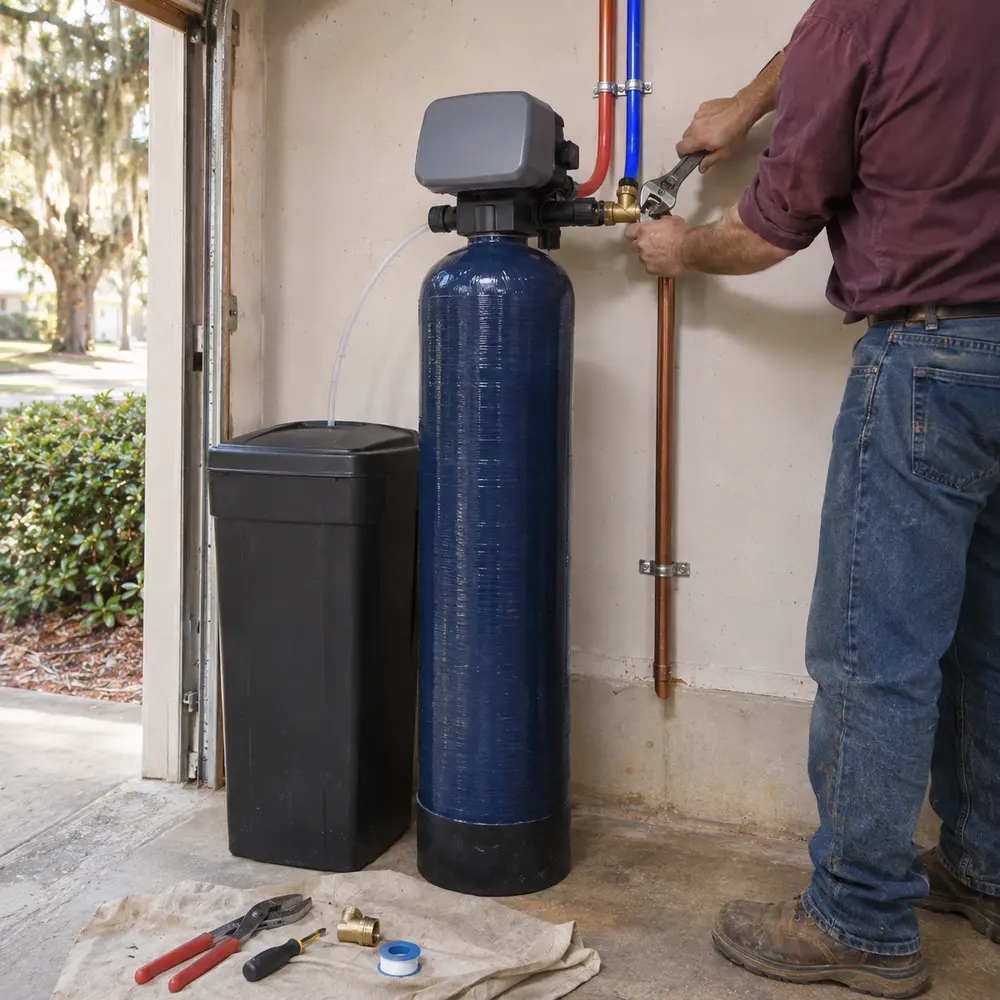
A softener is a resin tank and a brine tank. The plumbing around them decides whether it works well for years.
Hardness in grains per gallon and the number of people decide the softener's capacity.
Near where the main enters, with a drain and an outlet close by, often the garage or utility room.
Outside spigots and sprinklers stay on unsoftened water. Salt isn't good for lawns and gardens.
A bypass valve so water still flows during service, and a drain line with an air gap.
Hardness programmed, the brine tank filled with salt, and the first regeneration run.
Softener costs
Water treatment is priced by what your water needs and what's already in place, not by a single sticker price.
A softener alone costs less than a sediment filter, iron filter, softener and UV in a row. Each stage adds equipment and plumbing.
Some newer homes have a pre-plumbed loop for a softener, which makes the job much simpler. Others need new piping, a drain and an outlet.
City water is already disinfected and treated for sulfides. Well water often needs more stages before it's ready for a softener.
Scale already in the pipes doesn't vanish when a softener goes in, but it stops getting worse. Water heaters and faucets are where most people notice the difference first.
Every plumbing service in ValdostaQuestions
Do Valdosta homes even need one? Softeners versus filters, salt, sulfur smells and the downsides are answered below.
Call (229) 544-0276Not automatically. City water is treated at the plant, and the City publishes a yearly report on what's in the tap water. Wells vary a lot. Look for scale and spots, then test your water before buying anything. If the problem is smell, stains or taste, a filter may be the answer instead.
A softener removes hardness minerals through ion exchange, swapping calcium and magnesium for sodium or potassium. A filter removes other things, such as sediment, chlorine, iron, sulfur or bacteria, depending on the type. Many homes, especially on wells, use both.
A softener going into a pre-plumbed loop is usually a short job. Adding new piping, a drain and an outlet, or several treatment stages on a well, takes longer. You'll know the scope before work starts.
You add salt regularly, softened water carries some extra sodium, and the resin and valve need occasional service. It also uses some water for each regeneration. People watching their sodium often keep one kitchen tap unsoftened or add reverse osmosis there.
Salt-free conditioners reduce scale buildup without removing the minerals, so the water still tests hard. If hardness isn't your real problem, a carbon, iron or sediment filter may be all you need. A water test settles which.
It depends on the equipment, whether your home has a softener loop, and how many stages your water needs. You'll hear the price for equipment and installation before anything goes in. The page on plumbing prices in Valdosta explains how jobs are priced.
No. That smell is hydrogen sulfide, and a softener doesn't remove it. A carbon or oxidizing filter does. Even the City's plant uses air stripping towers and ozone to take hydrogen sulfide out of its well water.
It depends on how hard the water is, how much the household uses, and the size of the brine tank. Most people check it monthly and top it up when the salt runs low.
Keep reading
Pressure tanks, switches and pumps on private wells.
Sediment and scale building up in the tank.
Cartridges and aerators clogged with mineral scale.
Pumping and care for well-and-septic homes.
High water bills with no leak in sight.
How plumbing jobs are priced.
Hard Water or Bad Smell? Call Now
Softeners, whole-house filters and well water treatment. Tell us what the water is doing and talk the options through. If a water test comes first, the price still comes before anything goes in.