Soggy ground or standing water
Wet spots over the field lines in dry weather, or water that won't soak in.
Valdosta, GA · Drain field repair & replacement
Most of what a septic system does happens in the drain field, or leach field, the trenches in the yard where liquid from the tank soaks into the soil. When the field gives out, it's the biggest septic bill there is, and a drainfield replacement in Valdosta should only be on the table once a crushed pipe, a tipped distribution box or a clogged filter has been ruled out. Call Plumber Valdosta Fix any hour and hear what it would take, and what it costs, before anything is dug up. Sewage on the ground? Keep kids and pets away and cut back water use.
Call now, tell us what the yard and the drains are doing and get a price.
10+Years helping homeowners get it fixed
In the yard and the house
A failing field shows itself outside first. These are the signs to watch for, and the ones a pumper should mention after a pump-out.
Problems at the tank itself, like a broken baffle or a pump alarm, are a different job. Tank repairs in Valdosta
Wet spots over the field lines in dry weather, or water that won't soak in.
An odor over the field itself, not just at the tank lids.
Bright, fast-growing grass in lines that match the trenches below.
Drains slow down again within days or weeks of a pump-out.
Effluent flowing backward from the field while the tank is being pumped.
Slow drains and gurgling that come and go with the weather.
Before you replace
Plenty of “failed” fields turn out to be a broken part between the tank and the trenches. These get checked first, because each one costs a fraction of a new field.
Dig up and replace that section.
Usually a repairReplace or level the box so every line gets its share.
Usually a repairClean it, and keep cleaning it between pump-outs.
Usually a repairFix the leak and spread out laundry and showers.
Usually a repairSend that water somewhere else.
Usually a repairJetting or root cutting can reopen them, often for a while.
Buys timeWhen it really is the field. Over the years, a layer called biomat builds up where effluent meets the soil. Once it seals the trench bottoms, water can't soak in fast enough. Jetting, resting the field and additives can't undo that for long, and that's when replacement makes sense.
How it's done
From proving the old field has failed to the new one being covered over and the lawn put back.
Camera the outlet line, open the distribution box and check each trench. Dry lines past a crushed pipe mean a repair, not a new field.
Georgia requires soil evaluations to be done by people the Department of Public Health certifies. They check how fast water soaks into the soil, its percolation rate, and how high groundwater rises in wet seasons.
The design and the permit come through sized to the house, usually by its number of bedrooms.
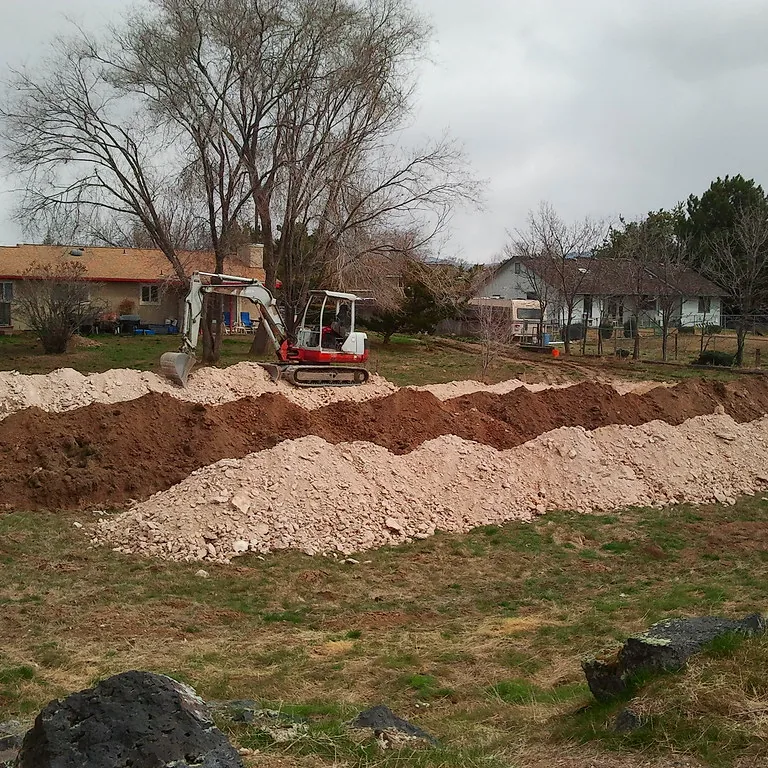
New trenches with gravel and pipe, or plastic chambers, laid level from a new or rebuilt distribution box.
The work is inspected before it's buried. Then the trenches are backfilled and the lawn is put back.
What goes in the ground
Georgia's septic rules recognize a few kinds of absorption field. The soil evaluation and the permit decide which one your lot gets.
Perforated pipe laid in trenches of washed gravel or stone. Georgia's rules call for aggregate between half an inch and two inches.
The classic absorption trench, and the design many older systems were built with.
Hollow, arch-shaped plastic chambers set in the trench instead of gravel, leaving open space for effluent to spread over the soil.
Lighter to install, and nothing to haul in by the truckload.
Approved designs that work differently from a standard gravel or chamber field, for lots where the soil or groundwater won't allow one.
The soil evaluation and the permit decide whether one is needed.
Wet seasons
A drain field only works when the soil around it has room for water. After days of heavy rain, groundwater rises toward the trenches and the field slows down, even a healthy one.
That's also why the soil evaluation for a new field looks at how high groundwater rises in wet seasons, not just on the day someone digs.
Georgia rules
Drain field work in Georgia runs through the county health department, under rules set by the state's Department of Public Health.
Under the rules, any repair, replacement or addition to an existing system needs a permit and an inspection. A contractor who skips the permit leaves you with work that was never approved.
Soil evaluations have to be done by people the Department certifies. Their findings, including seasonal high groundwater, set the size and type of the new field.
If public sewer can be reached when a system fails, Georgia's rules call for hooking up to it. If a sewer main runs past your lot, ask before designing a new field.
After it's in
A new field is a big investment. The EPA's care advice comes down to three things to keep off it, plus keeping extra water down.
“Do not park or drive on your drainfield.”
“Plant trees the appropriate distance from your drainfield to keep roots from growing into your septic system.”
“Keep roof drains, sump pumps, and other rainwater drainage systems away from your drainfield area.”
The EPA also notes that “excess water slows down or stops the wastewater treatment process,” so fix running toilets quickly and spread laundry across the week. Keep the tank pumped on schedule so solids never reach the new trenches.
Septic tank service in ValdostaDrain field costs
Two fields on the same street can price very differently. These four things explain most of it.
Fields are sized to the house, usually by the number of bedrooms, so a bigger house needs more trench.
Soil that drains slowly or a high water table can call for a larger field or an alternative system.
Fences, driveways and landscaping in the way add work, and so does the lawn that has to be put back.
The soil evaluation, design and permit are part of the job, not extras.
An estimate isn't a real price until someone has seen the site. These questions fill in what an estimate leaves out.
Questions
How long a field lasts, repair versus replacement, the Lowndes County permit, and why a system backs up after heavy rain.
Call (229) 544-0276Many last for decades. How long depends on the soil, how much water the household sends to it, whether solids from an overdue tank or a broken baffle have washed in, and whether roots or vehicles have damaged the lines. Regular pumping is the cheapest way to make one last.
Often, if the problem is mechanical, like a crushed line, a tipped distribution box, a clogged filter or a single blocked trench. When the soil under the trenches is sealed by years of biomat, the buildup that forms where effluent meets the soil, repairs only buy time and the field needs replacing.
Yes. Georgia's septic rules require repairs, replacements and additions to be permitted and inspected, and here the permit comes through Lowndes County Environmental Health.
It depends on the size the house needs, the soil and water table, whether an alternative system is required, access, and the lawn or driveway to put back. Ask for a written price after a site visit that lists the soil evaluation, permit and restoration.
The pipes can be cleared. Jetting pushes sludge and roots out of the perforated lines, and that can bring a struggling field back for a while. It can't unseal soil that biomat has clogged, so if the field fails again soon after, replacement is the real fix.
Usually not when a field simply wears out, which insurers treat as maintenance. Sudden damage, like a tree falling on the lines or heavy equipment driving over them, may be a different story. Check your policy and ask your agent before work starts.
Heavy rain raises the groundwater around the field, so it can't take water as fast. Cut back on water use until things dry out. If it happens with every storm, or roof drains are emptying onto the field, the field needs a closer look.
Sometimes, but it often goes in fresh ground next to the old one, because the old trenches are full of clogged gravel and soil. Georgia's rules treat a septic site as including a replacement area. The permit and the soil evaluation decide where it can go.
Keep reading
Regular pumping that keeps solids out of the field.
Baffles, filters and pumps that protect the field.
A whole new system, tank and field together.
A camera down the outlet line before any digging.
High-pressure cleaning for sludge-packed lines.
Sewage backing into a tub or shower tonight.
Soggy Yard Over the Septic? Call Us
From a cracked distribution box to a whole new field, priced before anything is dug up. Call and describe the yard.