A Warm Spot on the Floor
Tile, concrete or wood that feels warm in one place, often in a hallway or kitchen, is the classic sign of a hot water line leaking underneath. Pets sometimes find it first and start sleeping there.
Valdosta, GA · Under-slab water leaks
Most slab leaks start as a pinhole in a copper water line buried under the concrete floor, wearing through after decades and leaking day and night where nobody can see it. What makes slab leak repair in Valdosta affordable or painful is how the plumber reaches that pipe, whether through the floor, under it, or around it with a new line overhead. Call Plumber Valdosta Fix 24 hours a day and you'll hear the options and the price before anyone picks up a jackhammer. Tell us what flooring sits over the leak, because it changes the best fix.
Call now, tell us what you're noticing and get a price.
10+Years helping homeowners get it fixed
Warning signs
A slab leak hides under the one surface nobody looks beneath. These are the clues that water is escaping under the floor.
Tile, concrete or wood that feels warm in one place, often in a hallway or kitchen, is the classic sign of a hot water line leaking underneath. Pets sometimes find it first and start sleeping there.
A faint rushing sound that seems to come from the floor itself, even with every faucet closed and nothing running in the house.
Water wicks up through the concrete and shows at the edges first, as a wet carpet tack strip, a baseboard that swells or a musty smell along one wall.
Water running under the foundation for months can wash out the soil beneath it and let the slab settle, cracking tile or opening a new crack in the concrete.
With everything off, the water meter still turns. A slab leak runs around the clock, so the bill stays high month after month instead of spiking once.
If the water heater keeps running when nobody is using hot water, it may be reheating water that's leaking out under the floor as fast as it heats it.
Before anyone digs
Water on a slab floor doesn't always come from a water line. Ruling out the lookalikes first can save a lot of concrete.
If the meter box itself is leaking, or the pipe between it and the street, that repair belongs to the City of Valdosta. Contact City of Valdosta Utilities.
While you wait
A slab leak rarely needs a 2 a.m. callout, but it shouldn't run for days either. These steps slow it down and protect your claim.
Water coming up through the floor?
Close the main shut-off valve and call now. That's an emergency, not a wait-and-see.
Call (229) 544-0276Close the cold-water valve on top of the water heater and watch the meter. If it stops turning, the leak is on the hot side.
You keep cold water everywhere while the hot line waits for the plumber. Turn the water heater off at the breaker, or set a gas unit to vacation or pilot, so it isn't heating a tank with no supply.
Close the main shut-off valve whenever you don't need water and open it only to use it. That keeps the leak from washing out soil under the slab all night.
Lift wet rugs, pull back soaked carpet pad, run fans, and photograph everything before anything is thrown out. Wet pad and drywall can start to grow mold within a couple of days.
Finding it
The goal is one small, accurate opening, or none at all. A good locate gets close enough that the repair starts in the right square foot of floor.
With the house quiet, the water meter and a pressure gauge on an outside faucet show whether a line is losing water.
Closing valves one at a time narrows the search to one line, hot or cold, then the branch to one bathroom or the kitchen.
Line tracing with an electronic locator shows where the pipe really runs under the floor, so the search follows the pipe instead of a guess.
Acoustic equipment picks up the hiss through concrete. Pushing nitrogen or a tracer gas into the drained line makes a quiet leak louder or detectable, and thermal imaging shows the warm plume from a hot line.
Repair options
Once the leak is found, there are five ways to deal with it. The right one depends on where it is, what's on top, and how old the pipes are.
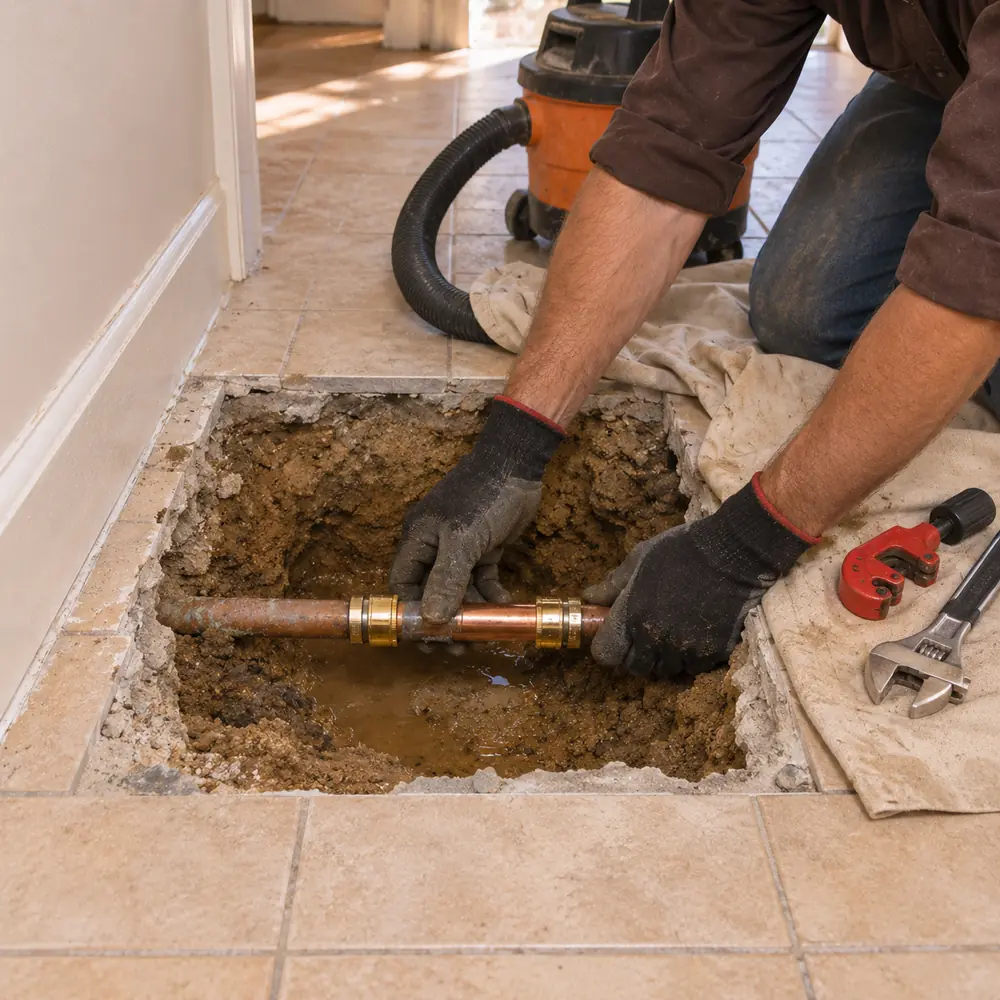
The plumber cuts a small opening in the floor right over the leak, often with a saw and a jackhammer, repairs the pipe, and fills the hole with new concrete. The flooring over that spot comes up and goes back down.
A tunnel is dug from outside, under the foundation, to the leak. Nothing inside the house is touched.
The leaking line is cut off and capped under the floor, and a new line, usually PEX, runs through the attic or walls to the same fixtures. The slab is never opened.
The line is dried, scoured clean inside with air and grit, then coated with epoxy that seals pinholes from the inside. There's no digging, but not every plumber offers it.
Every water supply line in the house is replaced overhead with new pipe, and the old lines under the slab are abandoned in place.
Repiping in ValdostaPatch or repipe?
Plumbers have a saying that slab leaks come in threes. It isn't a rule, but copper lines laid at the same time, in the same soil, wear out at about the same rate.
Paying for it
Most policies split a slab leak into two bills. The plumbing is usually yours, and the water damage often isn't. Every policy is different, so treat this as a guide to the questions, not an answer about yours.
Slab leak costs
Two slab leaks a few feet apart can be very different jobs. These four things set most of the price.
A leak near an outside wall is easier to reach than one in the middle of the house, under a kitchen island or a bathtub.
Bare concrete or carpet is simple to put back. Tile, hardwood or cabinets over the leak adds restoration work, which is when a reroute starts to make sense.
A small opening costs least when the leak is pinpointed. Tunneling rises with every foot, and a reroute depends on how far the new line has to run.
Fixing one leak is a different job from replacing every line. Pipe age and past leaks decide whether it's one line or the whole house.
Slab leak quotes vary a lot. These make two quotes comparable and show what each one really includes.
Questions
How leaks under concrete are found and fixed, what insurance covers, and whether it's safe to keep running water in the meantime.
Call (229) 544-0276Months, sometimes longer. Water can drain into the soil under the slab without ever showing on the floor, especially a cold-side leak, which makes no warm spot. A rising water bill and a meter that turns with everything off are often the only clues.
It depends on the size of the house and how hard the leak is to find. A hot-side leak that shows on a thermal camera is quicker to find than a quiet cold-side leak that needs tracer gas. Ask what the search costs before anyone comes out, and whether it comes off the repair.
The pipe is the cheap part. The price is set by how the plumber reaches it, what's on top of the slab, and whether concrete and flooring repair are included. Ask for a reroute price next to the direct-access price, since with finished flooring on top the reroute can be the lower total.
For a first leak in a sound pipe under easy flooring, a direct repair is fine. If the pipes are old, the flooring is costly, or this isn't the first leak, a reroute skips the slab entirely and ends the risk from that line. That's why many plumbers recommend it.
Usually not the pipe itself, but many policies cover water damage from a sudden leak and the cost of breaking out and replacing the floor to reach it. Slow leaks are often excluded, and service line add-ons may not cover pipes under the slab. Ask the claims department, and keep photos and the plumber's findings.
A direct repair or a single-line reroute is often done in a day. Tunneling and whole-house repipes take longer, and new concrete needs time to cure before the flooring goes back down.
Yes. Plumbers repair and reroute slab leaks every day. Some bring in a leak detection specialist to pinpoint the leak first, then make the repair themselves. See how leak detection works.
It can. Water running under the slab for a long time can wash out or soften the soil beneath it, letting the slab settle and crack. That's one reason not to wait once a leak is confirmed.
In short bursts, usually. Close the main shut-off, or the water heater's cold inlet for a hot-side leak, between uses so the leak isn't running day and night. If water is coming up through the floor, treat it as an emergency.
Keep reading
Not sure it's the slab? Start with the meter test.
New lines overhead when the old ones keep failing.
Leaks in walls, ceilings and under sinks.
The buried line from the meter to the house.
A heater that never stops running, or no hot water.
Water coming up through the floor right now.
Slab Leak in Valdosta? Call Us Now
Warm floors, a meter that won't stop, water under the flooring. Walk through the signs and find out what the fix would take.